Selling a property in India involves more paperwork than most people expect, and a fair amount of it is banking-related rather than purely legal. Here's what to line up, in roughly the order you'll need it.
1. Close out any existing home loan cleanly
If the property still has an active home loan, you'll need a formal loan closure / no-dues certificate from the lender, along with the original property documents they've been holding as security (title deed, sale agreement, etc.). Request these in writing and follow up — banks are required to release original documents within a defined period after full repayment (typically around 30 days), but delays are common enough that it's worth chasing early rather than at the last minute.
Also request an updated encumbrance certificate after closure, confirming the property is free of the loan's charge — buyers and their lenders will usually ask for this.
2. Keep the payment trail clean
Large property transactions attract scrutiny, and a clean banking trail protects you. Practical points:
- Insist on receiving sale proceeds via bank transfer (RTGS/NEFT) into an account in your name, not cash, and not split across many small transactions.
- Keep the sale agreement, payment receipts and bank statements showing the credit — you'll need these when filing your tax return for that year.
- If TDS (tax deducted at source) applies — generally when the sale value exceeds ₹50 lakh — confirm the buyer has deducted and deposited it, and collect Form 16B as proof.
3. Work out your capital gain
Broadly, your capital gain is the sale price minus the indexed cost of acquisition (and improvement, if any) minus transfer expenses like brokerage. Whether the gain is treated as short-term or long-term depends on how long you held the property — long-term treatment generally applies beyond a multi-year holding period, and comes with more favourable tax treatment and indexation benefit. The exact holding period and rates are set by current income-tax law and are worth confirming with a tax professional, since these details are periodically revised.
4. Section 54: reducing tax by reinvesting in a home
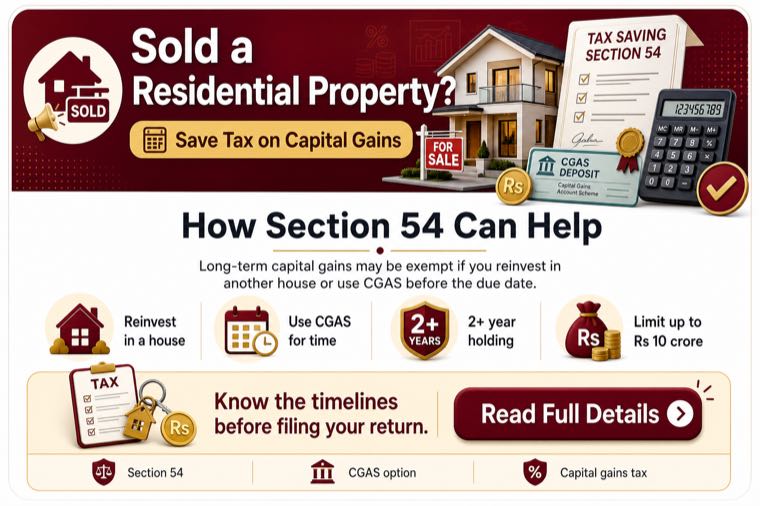
Under Section 54 of the Income Tax Act, individuals and HUFs selling a long-term residential property can claim an exemption on long-term capital gains if the gain (not the full sale proceeds) is reinvested in another residential property within specified timelines — broadly, purchasing within 1 year before or 2 years after the sale, or constructing within 3 years after. There are caps and conditions (including a limit on the number of times this exemption can be used across the eligible amount, and rules if you don't complete the reinvestment before your tax return is due), so this needs to be planned carefully rather than assumed.
If you can't reinvest before filing your return, the unutilised gain can typically be parked in a Capital Gains Account Scheme (CGAS) at an authorised bank, which preserves your eligibility for the exemption while you complete the purchase or construction within the allowed window.
5. Documents to keep for at least 6–8 years
- Original and sale-value purchase agreements, with stamp duty receipts.
- Loan closure letter and encumbrance certificate.
- Bank statements showing sale proceeds credited.
- Form 16B (TDS certificate) if applicable.
- CGAS deposit and withdrawal records, if used.
- Purchase documents for any reinvestment property claimed under Section 54.
This isn't a substitute for advice from a chartered accountant, especially given how specific the timelines and caps under Section 54 are — but knowing the shape of the process before you sell makes that conversation much shorter.