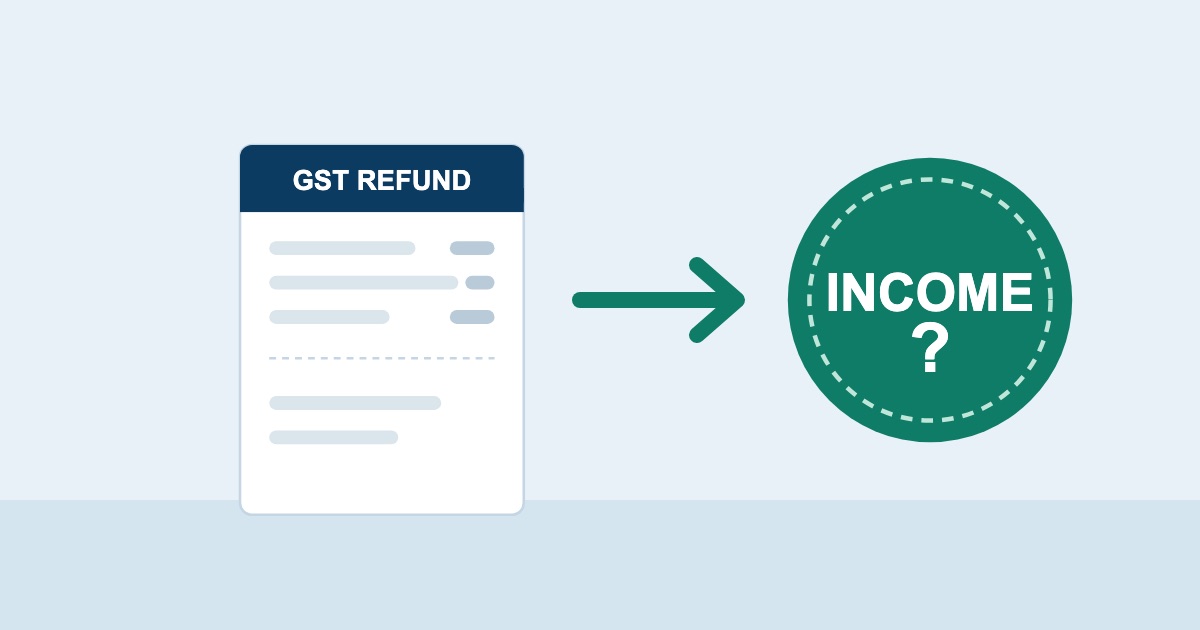
You paid GST, claimed it back, and the refund reached your bank account. Then the income-tax department counts that refund as your income and sends a demand. Can it do that?
In a recent case, the Delhi bench of the Income Tax Appellate Tribunal (ITAT) sided with the taxpayer. The answer depends on one thing: how the GST was recorded in your books.
What happened in this case
The taxpayer ran a small manufacturing business as a proprietor and declared income of about ₹4.94 lakh for assessment year 2022-23. While processing the return, the department's Centralised Processing Centre (CPC) added a GST refund of ₹3.98 lakh as income.
That took the assessed income to about ₹8.92 lakh and led to a tax demand of ₹88,750.
Why the refund was added as income
The refund was mentioned in the tax audit report, under Clause 16(b) of Form 3CD. The CPC treated that entry as income that had been left out of the return.
The taxpayer said the entry was only a reporting requirement. The GST had been kept in the input credit ledger and shown in the balance sheet. It was never charged to the profit and loss account as an expense, so getting it back was not a profit. A rectification request was rejected, and the matter went to the tribunal.
What the tribunal said
- GST is a tax collected and paid to the government. A refund of it is a return of money already paid.
- Since the GST was not claimed as an expense, the refund could not be treated as income.
- Being mentioned in the tax audit report does not, by itself, make a refund taxable.
The tribunal allowed the appeal and asked the assessing officer to give effect to the claim after checking the documents.
When a GST refund is usually not taxable
If the GST you paid was held in a balance sheet account, such as the input credit ledger or a refund receivable, and you did not deduct it when working out your business profit, the refund simply brings back your own money. This is the situation the ruling covers.
When it can be taxable
The ruling does not make every GST refund tax-free. If you had charged the GST as an expense and reduced your taxable profit with it, getting it back later can be taxed, subject to the conditions in Section 41(1) of the Income-tax Act, 1961.
| How GST was recorded | Refund received later |
|---|---|
| In the balance sheet, not claimed as an expense | Generally not income |
| Claimed as an expense in the profit and loss account | Can be taxable |
What to keep ready
- GST input credit ledger and electronic cash and credit ledger statements
- Refund application, refund order and bank credit entry
- A reconciliation of GST returns with your books
- Profit and loss account showing the GST was not claimed as an expense
- Tax audit report with a clear note against the refund entry
If you get a demand like this
- Read the intimation and find the exact adjustment and clause it refers to.
- Check with your accountant how the GST was recorded in that year.
- Respond on the e-filing portal, or ask for a rectification, with your ledgers attached.
- If that is rejected, ask a tax professional about filing an appeal. Time limits apply, so do not wait.
Keep in mind that a tribunal ruling is decided on its own facts and can be challenged in a higher court. Your own books decide how strong your case is.
Case: ITA No. 2537/Del/2026, ITAT Delhi, order dated 25 September 2026, as reported by Mint via MSN. This article is for general information only and is not tax advice.